
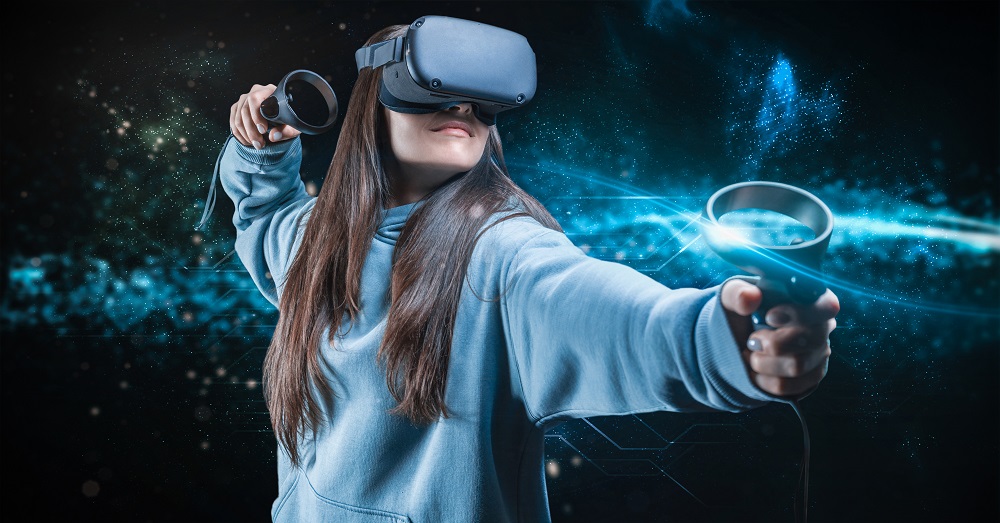
Virtual reality (VR) has revolutionized gaming by creating fully immersive environments that allow players to experience digital worlds in ways never before possible. Unlike traditional gaming platforms, VR places players directly inside the game, providing a sense of presence and interaction that extends beyond visual and auditory engagement. This technology has transformed both entertainment and experiential gaming, offering new opportunities for storytelling, exploration, and gameplay innovation.
The development of VR in gaming has been closely tied to advancements in hardware and software. Early VR systems, such as Sega VR, were experimental and limited by technology, offering basic 3D visuals and head tracking. However, modern VR headsets, including the Oculus Rift, HTC Vive, and PlayStation VR, provide high-resolution displays, precise motion tracking, and intuitive controllers, creating an immersive and interactive gaming experience. The combination of powerful graphics, low latency, and responsive input systems enables players to feel fully engaged in virtual worlds.
One of the defining features of VR gaming is interactivity. Players can manipulate objects, navigate environments, and engage with characters in real time, enhancing the sense of agency and immersion. Games such as Beat Saber and Half-Life: Alyx demonstrate how VR transforms traditional gameplay mechanics into physical and interactive experiences. Players are not just controlling a character on a screen—they are moving, gesturing, and interacting within the digital space, creating a more engaging and physically active form of gaming.
VR also expands opportunities for storytelling and narrative immersion. Developers can design experiences where players feel like active participants in the story rather than passive observers. Games like Lone Echo leverage VR’s immersive capabilities to create emotionally resonant narratives, where players’ decisions, movements, and interactions directly influence the outcome. This approach transforms gaming into a cinematic and participatory art form, blending gameplay with storytelling in compelling ways.
The social dimension of VR gaming is another area of growth. Multiplayer VR experiences, such as VRChat and Rec Room, allow players to interact with others in shared virtual spaces. Users can communicate through voice, gestures, and avatars, participating in cooperative missions, social events, or casual hangouts. VR social platforms blur the line between gaming and social interaction, creating communities that transcend geographic boundaries.
VR technology is not limited to entertainment; it also enhances educational and training applications. Simulation-based VR games provide safe environments for learning complex skills, such as piloting, surgery, or tactical operations. Gamified VR experiences can teach problem-solving, critical thinking, and coordination in immersive settings. These applications highlight the potential of VR to transform not only gaming but also professional development and experiential learning.
Despite its advantages, VR gaming faces challenges. Hardware costs remain high, and extended gameplay can cause motion sickness or fatigue for some players. Developers must carefully design interactions, movement mechanics, and environments to minimize discomfort and maximize engagement. Content creation for VR is also more complex and resource-intensive than traditional games, requiring specialized skills in 3D modeling, spatial design, and motion programming. Accessibility remains a concern, as not all players have the necessary equipment or physical ability to fully participate.
The future of VR gaming is promising, with emerging technologies further enhancing immersion and realism. Advances in haptic feedback, eye-tracking, and wireless VR will increase sensory engagement, allowing players to feel touch, motion, and spatial awareness in virtual worlds. AI-driven NPCs will create more responsive and adaptive game worlds, enhancing interactivity and replayability. Integration with AR and mixed reality (MR) will expand hybrid experiences, blending physical and digital environments for innovative gameplay.
In conclusion, virtual reality has redefined gaming by immersing players in interactive, engaging, and socially connected digital worlds. Through advanced hardware, intuitive controls, and innovative game design, VR transforms traditional gameplay into a physically and emotionally immersive experience. While challenges such as accessibility, cost, and comfort remain, VR continues to expand the possibilities of gaming, creating experiences that are more interactive, narrative-driven, and socially connected than ever before. As technology progresses, VR will play an increasingly central role in shaping the future of gaming and interactive entertainment.